INSTALLATIONS AND PERFORMANCES

Pirelli’s works/inventions are flexible
instruments for public art interventions
and installations that poetically
transform the perception of space.
They come to life through the artist’s
presence, but can also operate
autonomously in Live Installations
— compositions designed for
immersive environments that can,
at times, become responsive environments.
They are presented in natural settings,
historic buildings, museums, theatres,
industrial spaces, bridges, streets,
and places of worship.
IDROFONI, OR SENSITIVE LAMPS
“In small pelaghi, one and the same
stroke gives birth to many
motions of advance and recoil.
The greatest wave is covered with
innumerable other waves which
move in different directions.”
Leonardo da Vinci,
Del moto e misura dell’acqua

PLAYING WATER, PLAYING LIGHT
The energy of sound is transmitted to
the surface of the water, generating the
waves of a small pelago traversed by light.
In the rippling water, sound becomes visible.
By touching, singing and playing,
Pirelli sculpts shadows of light into
ever-changing forms that echo through space.
IDROFONO also listens to the
chaotic soundscape of the metropolis
and transforms it into Flowers of Light,
drawing the audience around it like a hearth.
Designed in collaboration with Carlo Forcolini
ARPA di LUCE

ARPA DI LUCE
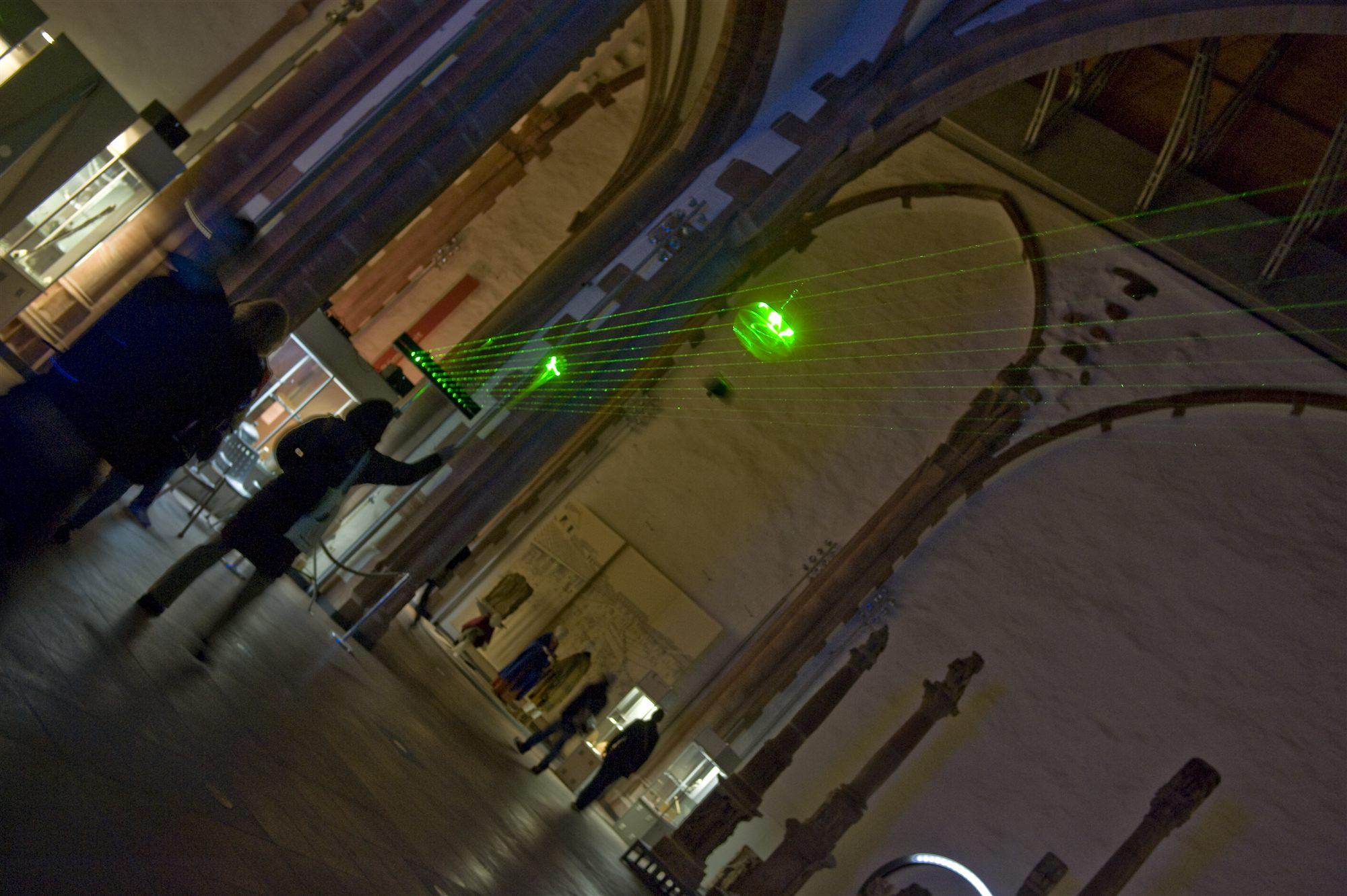
By plucking light strings in the air, Pirelli gives voice to a harp—yet his fingers meet no resistance. Perhaps this is the magical and transcendental mystery of this work, created together with engineer Gianpietro Grossi. Pirelli likes to place it in places of worship. But its long beams can just as easily span the walls of an industrial warehouse, turning the space into a vast soundboard and resonating chamber for a grand musical instrument. In this way, even the most ordinary place is transformed. Some presentations include: Luminale Frankfurt 2010; Venice Biennale 2011; Nazareth 2012; Ponte del Diavolo, Modena 2013; Piazza Duomo, Monza 2013; Piccolo Teatro Studio, Milan 2013; Digitalife / Romaeuropa 2014; Teatro Dal Verme, Milan 2015; Trepponti di Comacchio / Ravenna Festival 2015; Kamakura Temple and Tokyo Metropolitan Theatre 2016, for Japan Orfeo. ... Arpa di Luce originates from Gianpietro Grossi’s laser harp: eleven parallel laser beams reach eleven photocells positioned at distances of up to 30 metres, which is currently the maximum scale of the instrument. The sensors respond immediately and precisely. When a beam is interrupted, the resulting impulse is processed by software developed by AGON, allowing the sound to retain the complexity and sensitivity of the musician’s gesture. The shape of the fingers, or of objects passing through the light strings, determines the timbre and rhythm of the sounds produced. “My fingers cross eleven strings of laser light. Meeting no solid matter, they move freely through the air. When touched, light materialises as the sound of a harp. Each contact is a snap of light and, with my arms reaching towards the sky, I learn to move through the air until I become a virtuoso of emptiness. I set in motion a pendulum suspended from an invisible point above, brushing against the laser strings and playing an endless melody that reverberates as light, projecting rippling circles. I mute the sound of the harp and, in the silence, the music seems to continue through vision alone. The light strings stretch across the architectural space, transforming it into a vast musical instrument. If touching light produces sound, does light have a body? This enchantment, suspended between the material and the immaterial, led me to explore a new poetic dimension beyond the technological wonder of what is, in fact, a true musical instrument. Concrete objects enter the scene—objects with their own voices that can also reflect light. I attach a large cymbal to the pendulum: struck and set in motion, it generates a trail of sound around the beams of light. A flexible tube spins and whistles, its sound intensifying when the tube lights up as it crosses the laser strings. The long pendulum descends, its plectrum simultaneously plucking flashes of light and sound. It travels through the strings, bending their lines into rotating forms of light that materialise as circles across the walls of the space. I light two sticks of incense fixed to the plectrum, so that a trail of smoke traces the pendulum’s path across the strings. A transparent rod lights up entirely whenever it touches a single beam. I use it like a bow to play the Seikilos Epitaph. I have tuned the instrument to this melody, preserved in the musical notation of ancient Greece. Then I reach upwards, intercepting all the beams at once. They are deflected into a cluster of sound and light that materialises as a musical staff”. The installation may be set outdoors, under the rain, or in large interior spaces, suspended from a tower or beneath the arch of a bridge. Together with Gianpietro Grossi, I look for the point from which to lower the pendulum: at times we create a delicate web of cables, from which the string descends invisibly, like a hand playing from the sky. The higher it is suspended, the slower the breathing of its endless melody. The plumb line establishes the fulcrum of the installation, making the surrounding architecture itself resonate.
Read MoreLaser Wave Pendulum
To enter without
being struck,
one must understand
its silent music.

A LINE OF 11 LONG PENDULUMS PLAYS ARPA DI LUCE
“I set in motion a line of pendulums of graduated length and obtain a becoming of oscillatory relationships that never ceases to enchant me. It is a music without sound, moving from the predictable order of a serpentine motion to a complex combination, almost chaos, only to reveal, for a few moments, figures that become intelligible once again. ... I like to imagine each pendulum as an individual taking part in a choral flow. Within that flow I perceive a tunnel into which one can venture. To enter it without being struck, one must understand its wave. These are numerical relationships that I grasp with the mind, but even more through the intuition of the body.” The timing of one’s steps then meets that of the eleven pendulums. The eleven pendulums cross eleven strings of light in brief flashes. With our Arpa di Luce, that silent wave finds a voice, reverberating as a sound that rotates through space. We know that the oscillation period of a pendulum depends on the length of its arm. If we suspend a number of pendulums of graduated length from a rigid bar, each one will oscillate with a slight delay in relation to the previous one. Although they are set in motion simultaneously, their oscillation will only appear simultaneous at first; soon, the delay each pendulum accumulates in relation to the previous one becomes evident. The line begins to take on a sinusoidal wave pattern, gradually evolving into ever more complex drawings. The pendulum strings brush against the Laser Harp and, by interrupting its beams, initially produce an arpeggio that then transforms into a complex polymetric combination of melodic figures.”
Read MoreSound Scenography for the theatre production Alan Turing, A Staged Case History. Piccolo Teatro di Milano, 2012 season.
The mathematician and athlete Alan Turing observes the numerical relationships of the wave pendulum and manages to cross it several times without being struck.
Technight Cremona 2017 — A tribute marking the 450th anniversary of Claudio Monteverdi.
“In the Loggia dei Militi, I built a bamboo structure supporting the row of pendulums. It becomes a large animated sculpture, which I set in motion to the music of Possente spirto from Monteverdi’s Orfeo”.

ARTIFICIALE NATURALE
By man’s hand 2012 Multisensory sculpture/environment for soapstone petals,
audio pickups, surround sound, an ice hand, ropes and pulleys, and laser lights.
From the fingers of a suspended hand of ice, drops of water fall. They shatter upon a large stone flower, whose petals compete for the point of impact. They remain in an unstable balance: the slightest contact is enough to set them swaying. Fitted with highly sensitive pickups, when struck by direct or rebounding drops they are free to vibrate, each producing its own distinct sound.
This lithophonic music intensifies over time and then fades away as the fingers melt. Struck by laser beams, the hand becomes luminous with the colour of the light and, as it melts, dissolves into a shapeless form, revealing marvellous veins within. Tiny epidermal rivulets slowly slide down and gather along the fingers, forming the drop that will fall and sound.
This slow unfolding is magnified by the lasers into magmatic projections that take shape across the surrounding walls. As with lightning and thunder: first it is seen, and then it is heard.
OTHER PROJECTS